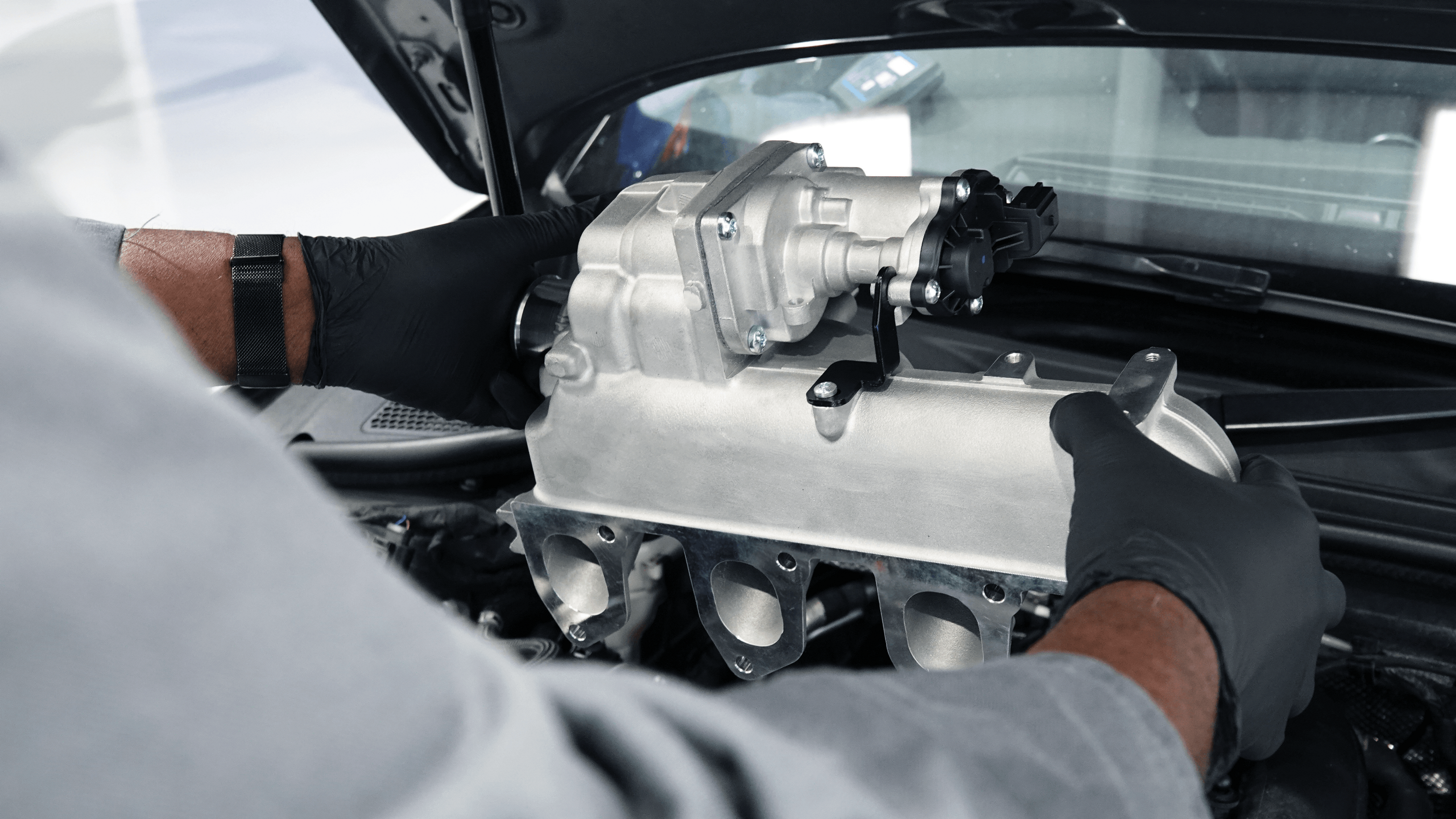
The quality and durability of a part affect its function. They impact the engine and emissions, and for workshops, they can influence your bottom line.
Here at Delphi, we understand these connections, and so we put our parts to the test to ensure they deliver.
Recently, it was EGR valves in the hot seat.
EGR valves regulate the flow of exhaust gases back into the combustion chamber. This lowers combustion temperatures, which cuts NOx emissions and allows the engine to run more efficiently. But that only works if the valve opens and seals exactly as it should. Too soon, and you lose power. Too late, and emissions rise.
Faulty sealing? Expect poor fuel economy and long-term damage.
We tested Delphi EGR valves against their OE equivalents. Here’s an overview of the results…
Vacuum pressure
The vacuum pressure test checks when the valve starts to open and what pressure it takes to fully actuate. These numbers need to be precise. Deviations can throw off ECU timing and emissions calculations.
Delphi’s EGR valves started opening at a vacuum pressure of 0.02. The OE valves opened slightly earlier, at 0.01. That’s a negligible difference, and both fall well within spec.
To fully open, Delphi valves needed 7.54 of vacuum pressure. OE valves reached full actuation at 7.05. Again, the variance is minimal. What matters most is that both products trigger within acceptable thresholds and mirror the pressure response curve needed for effective EGR flow.
This confirms that Delphi valves hold up in terms of accuracy and performance consistency under load.
Component leakage
We ran two separate tests here: one for valve leakage and one for internal sleeve leakage.
Both are critical. A small leak can be enough to degrade combustion efficiency and lead to emissions test failures.
In the valve leakage test, two out of three Delphi samples outperformed the OE equivalents. Delphi valve one measured at 0.64, and Delphi valve three came in even lower at 0.34. The other Delphi unit registered the highest value at 6.21 but still came in under the industry’s acceptable leakage threshold. OE samples ranged from 0.54 up to 2.67.
So while the highest Delphi sample flagged higher than ideal, it didn’t fail. And two of the three beat the OE parts outright.
Internal sleeve leakage testing told a similar story:
- Delphi valves one and three both came in at 0.04.
- Delphi two measured at 0.15.
- The OE side was mixed - valves two and three had no measurable leakage, but OE one showed a high value of 2.42.
That outlier shows the importance of testing at the component level. A high internal sleeve leak like that can slowly undermine system pressure and fuel economy.
500,000-cycle durability test
The final test simulated long-term, real-world usage. Over 500,000 open and close cycles. Repeated thermal and pressure stress. Real operating conditions, just compressed into a controlled window.
All Delphi EGR valves passed without a single issue.
No change in sealing, no drop in actuation response, and no signs of mechanical fatigue.
So where do we stand?
Delphi EGR valves perform consistently close to OE.
In some areas, they even come out ahead. They hit the same vacuum pressure targets and hold a tighter seal in some scenarios. And they pass durability testing that pushes components far beyond standard use.
Delphi delivers quality you can trust
Innovation doesn’t mean overengineering. It means creating a part that works exactly as it should now—and throughout real-world use.
For us, it’s about integrity. We deliver on our promises, and we’re willing to prove that our parts match or exceed OE quality. That’s the Delphi difference.
Related News Articles

Find out where to buy Delphi parts