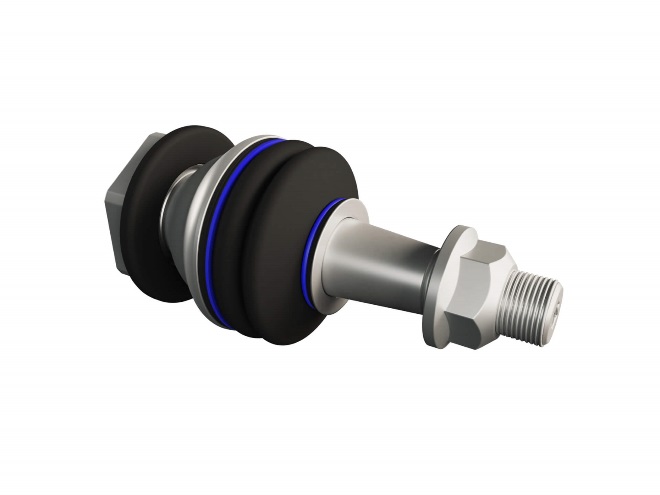
- Product Information
- Product Resources
- Enquire
- Related Products
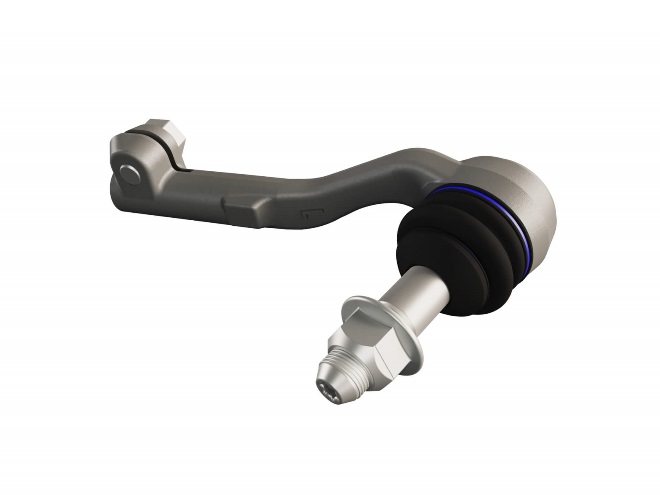
Why should you trust Delphi for ball joints?
- Manufactured with high-quality forgings for increased strength and smooth operation.
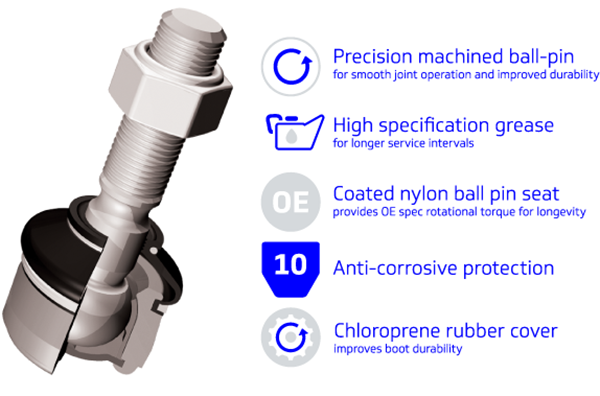
- Chloroprene rubber boot improves durability and prevents premature failure, with cover to protect internal components.
- Machined to micron tolerances to guarantee durability and smooth joint operation.
- Anti-corrosion protection applied to each part.
- Ball-pin 100% crack tested for flaw free material.
- Undergo rigorous performance and resilience tests.
- Superior ball-pin finish and nylon seat coating for smooth movement and long lifetime.
- High specification grease for reduced friction, and smooth operation in all temperatures and conditions.
What does a ball joint do?
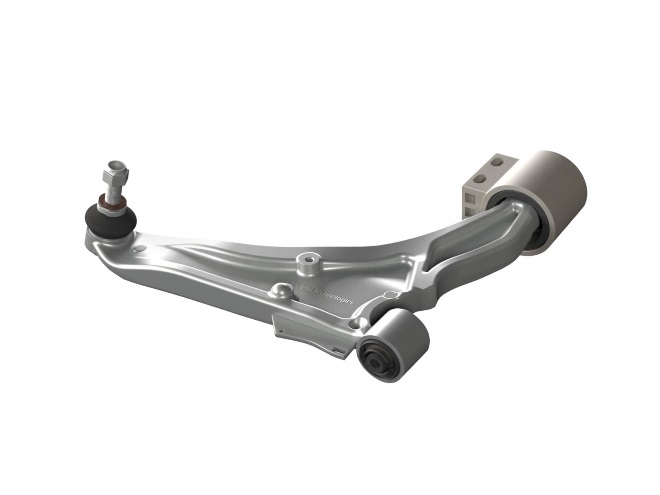
Think of the ball joint like a human hip joint. It acts as a pivot between the vehicle’s wheels and suspension, allowing the vehicle to be steered while ensuring a comfortable ride.
Why does a ball joint fail?
The ball joint’s constant motion subjects it to significant stress and wear. If it is worn out or its rubber boot splits or cracks, it needs to be replaced. So, you’ll want to fit a high-quality ball joint that has been designed, engineered and manufactured to the same standards as OE. Make sure to replace the entire ball joint and not just the ball joint boot. A damaged boot can let in contaminants that could corrode and/or impact the smooth feel of the ball joint. It can also lose grease lubricant, which is intended to last the life of the joint, causing significant friction and possible sticking.
Learn more about ball joint failure symptoms.
Precision engineering
Enabling free movement in two planes at the same time, the ball-pin is a critical component. That’s why our ball-pins are manufactured from high-grade steel and machined to micron tolerances. Together with a polyoxymethylene nylon ball-pin seat, they provide optimum durability and smooth joint operation.
Extensive testing
Delphi ball joints undergo rigorous performance tests including angular stress testing, where the ball is rotated through its angular and rotational travel under load, as well as a pull and push out test, to measure the force required for it to break away from the housing. These important safety tests ensure the ball joint can withstand the same forces as the OE part.

Cataphoretic coating
Like many of our steering parts, Delphi ball joints feature an environmentally friendly cataphoretic coating for tougher and longer lasting protection from corrosion caused by salt, dirt and water and other contaminants.
Greater protection
To help prevent damage to the joint’s internal components, all our ball joints come with a special chloroprene rubber cover. The new and improved formula maintains its durability even in extreme temperatures, providing added protection from road dirt or salt and allowing continued free movement of the ball joint for a longer lasting par
Longer service intervals
We provide a range of sealed ball joints, that are lubed for life with a high-specification grease, to minimize maintenance requirements. Alongside our precision ball-pin finish and improved rubber boot design, they offer longer ball joint service intervals and better grease retention.
Click here to view our catalog
The Delphi Difference
-
100 years of OE experience, supplier to the world’s top automakers
-
OE heritage and knowledge built into every aftermarket part
-
Comprehensive portfolio for a wide range of vehicles and model years
-
Streamlined SKUs for easy inventory management
-
Support through tools, tips and training

Related product resources and downloads

Resource Highlights
In this article you will find out about how to diagnose a shaking steering wheel. Here we provide an insight into the main causes, symptoms and fixes to help you streamline your repair work.

A worn, faulty or out of balance chassis component can be felt through a vibration in the steering wheel. Either as a shimmy, jiggle, or shake. However, because multiple parts can cause this, finding the root cause can be both frustrating and time-consuming for even the most experienced technicians. Here we provide an insight into the main causes, symptoms and fixes to help you streamline your repair work.
Tyre balance
The weight distribution in every tyre varies slightly. To compensate for this, additional weights must be added to the wheel after a new tyre is installed. Unfortunately, these weights can easily be displaced, resulting in an unbalanced wheel. A common cause of steering wheel vibration, this is usually felt at higher speeds, and becomes progressively worse the faster the vehicle gets. On a positive note, it is also relatively easy to fix. Simply perform a wheel balance and check each tyre for any damage and wear. If ignored, unbalanced wheels can cause wear and tear to struts, shocks and other steering and suspension components. It’s therefore best to do this sooner rather than later.
Wheel misalignment
Another common cause of steering wheel vibration is the incorrect positioning of the wheels. One of the quickest ways to diagnose misalignment is to check the tyre’s tread. A misaligned car will often have an uneven tread, with the inside worn much more than the outside. Similarly, if the steering wheel is straight and centered, yet the vehicle still pulls to either side, it’s also likely to be misaligned. Performing a simple wheel alignment, will ensure all wheels are positioned in the same direction.
Damaged or worn wheel bearings
If the tyres and wheels are ok, your next go-to part should be the wheel bearing. Designed to secure the wheel hub to the vehicle’s suspension, and allow the wheels to turn properly, these safety critical components can cause steering wheel vibration if damaged or not lubricated sufficiently. In this instance, the steering wheel will usually only shake when turning. However, to check for sure, securely raise the vehicle, and with both hands on the tyre, in the 12 and 6 o’clock position, rock the wheel. There should be minimal movement. If it moves more than it should, or you hear a grinding noise when rotating, it’s likely that the wheel bearings are damaged. These will need replacing as soon as possible.
Worn steering or suspension parts
It only takes a small amount of play or looseness in any one steering and suspension component to make the whole system noticeably slack. As well as affecting the vehicle’s control and stability, this can also cause steering wheel vibration. It’s therefore important to inspect the system for loose or worn components. Start by checking visible parts like the upper or lower ball joints, tie rod ends and bushings. If you see any signs of damage or excessive play, it is probably faulty and should be replaced. Similarly, loose shock mounts, damaged or detached springs and leaking shocks or struts can cause vibration in the steering wheel. These should be checked and replaced as necessary.
Brake problems
If the steering wheel only shakes when stopping its more likely down to the braking system. This is often referred to as brake judder and can be caused by disc thickness variation (DTV), loose wheel bearings and installation issues. A shaking steering wheel can also be caused if the brakes drag due to a mechanical or hydraulic fault. Or if the parking brake is engaged in error. To resolve suspected brake related issues, first measure the thickness of the brake rotor or disc using a brake disc micrometer. If it’s outside manufacturer’s tolerances, then it cannot be serviced and must be replaced. In addition, always ensure that the hub and disc mounting faces and brake caliper carriers are clean, the slider pins are lubricated and moving freely, and the wheel fasteners and disc positioning screws are correctly torqued.
Steering wheel shake can be caused by any one or more, of these, and other issues. For example, a worn joint leading to excessive tyre wear. This can complicate diagnosis somewhat. It’s therefore important to diagnose and repair any faults quickly. Whilst vibration issues can be caused by something as simple as a loose bolt or a deflated tyre, they can also signal a much bigger problem. If ignored, these could negatively impact the vehicle’s safety and stability. By following these steps, you can rule out any such issues in a logical order, saving valuable time, money and frustration.

Visit our Technician Library for access to Documents and Downloads
Get in touch

Contact Us
Visit our Contact hub to find a range of enquiry types suited to help you find the exact support you are looking for.