- Product Information
- Product Resources
- Enquire
- Related Products
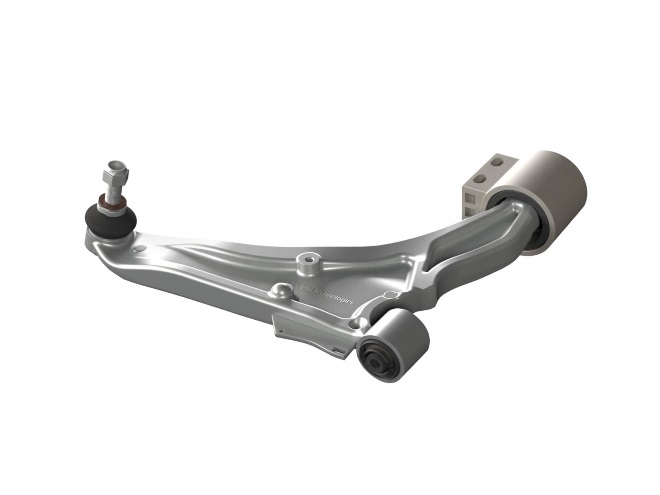
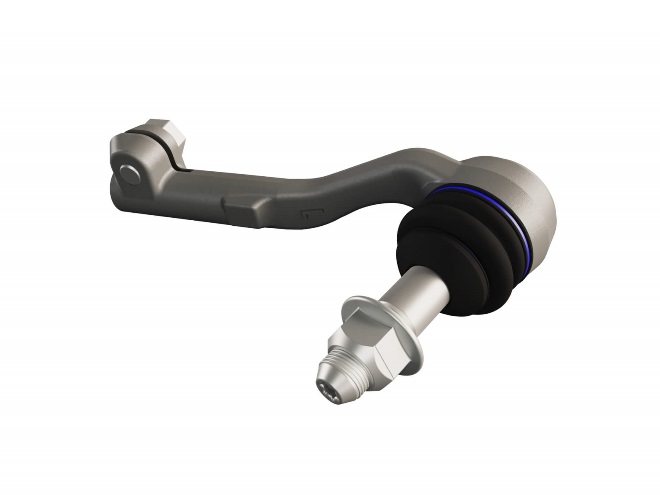
Why should you trust Delphi for ball joints?
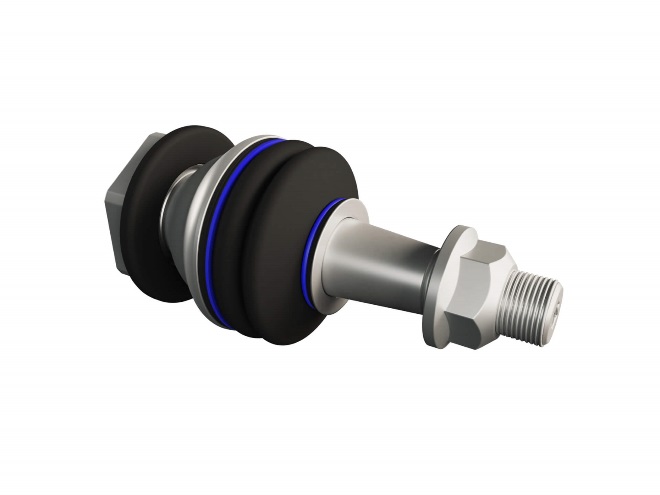
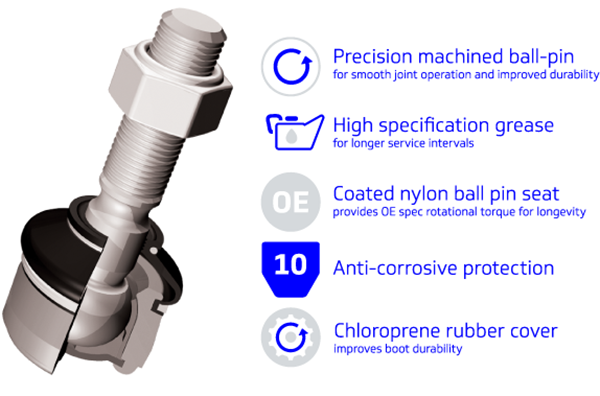
- Manufactured with high-quality forgings for increased strength and smooth operation.
- Chloroprene rubber boot improves durability and prevents premature failure, with cover to protect internal components.
- Machined to micron tolerances to guarantee durability and smooth joint operation.
- Anti-corrosion protection applied to each part.
- Ball-pin 100% crack tested for flaw free material.
- Undergo rigorous performance and resilience tests.
- Superior ball-pin finish and nylon seat coating for smooth movement and long lifetime.
- High specification grease for reduced friction, and smooth operation in all temperatures and conditions.
What does a ball joint do?
Think of the ball joint like a human hip joint. It acts as a pivot between the vehicle’s wheels and suspension, allowing the vehicle to be steered while ensuring a comfortable ride.
Why does a ball joint fail?
The ball joint’s constant motion subjects it to significant stress and wear. If it is worn out or its rubber boot splits or cracks, it needs to be replaced. So, you’ll want to fit a high-quality ball joint that has been designed, engineered and manufactured to the same standards as OE. Make sure to replace the entire ball joint and not just the ball joint boot. A damaged boot can let in contaminants that could corrode and/or impact the smooth feel of the ball joint. It can also lose grease lubricant, which is intended to last the life of the joint, causing significant friction and possible sticking.
Learn more about ball joint failure symptoms.
Precision engineering
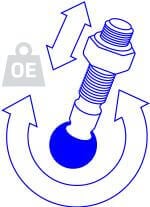
Enabling free movement in two planes at the same time, the ball-pin is a critical component. That’s why our ball-pins are manufactured from high-grade steel and machined to micron tolerances. Together with a polyoxymethylene nylon ball-pin seat, they provide optimum durability and smooth joint operation.
Extensive testing
Delphi ball joints undergo rigorous performance tests including angular stress testing, where the ball is rotated through its angular and rotational travel under load, as well as a pull and push out test, to measure the force required for it to break away from the housing. These important safety tests ensure the ball joint can withstand the same forces as the OE part.
Cataphoretic coating
Like many of our steering parts, Delphi ball joints feature an environmentally friendly cataphoretic coating for tougher and longer lasting protection from corrosion caused by salt, dirt and water and other contaminants.

Greater protection
To help prevent damage to the joint’s internal components, all our ball joints come with a special chloroprene rubber cover. The new and improved formula maintains its durability even in extreme temperatures, providing added protection from road dirt or salt and allowing continued free movement of the ball joint for a longer lasting par
Longer service intervals
We provide a range of sealed ball joints, that are lubed for life with a high-specification grease, to minimize maintenance requirements. Alongside our precision ball-pin finish and improved rubber boot design, they offer longer ball joint service intervals and better grease retention.
Click here to view our catalog
The Delphi Difference
-
100 years of OE experience, supplier to the world’s top automakers
-
OE heritage and knowledge built into every aftermarket part
-
Comprehensive portfolio for a wide range of vehicles and model years
-
Streamlined SKUs for easy inventory management
-
Support through tools, tips and training

Related product resources and downloads
Resource Highlights
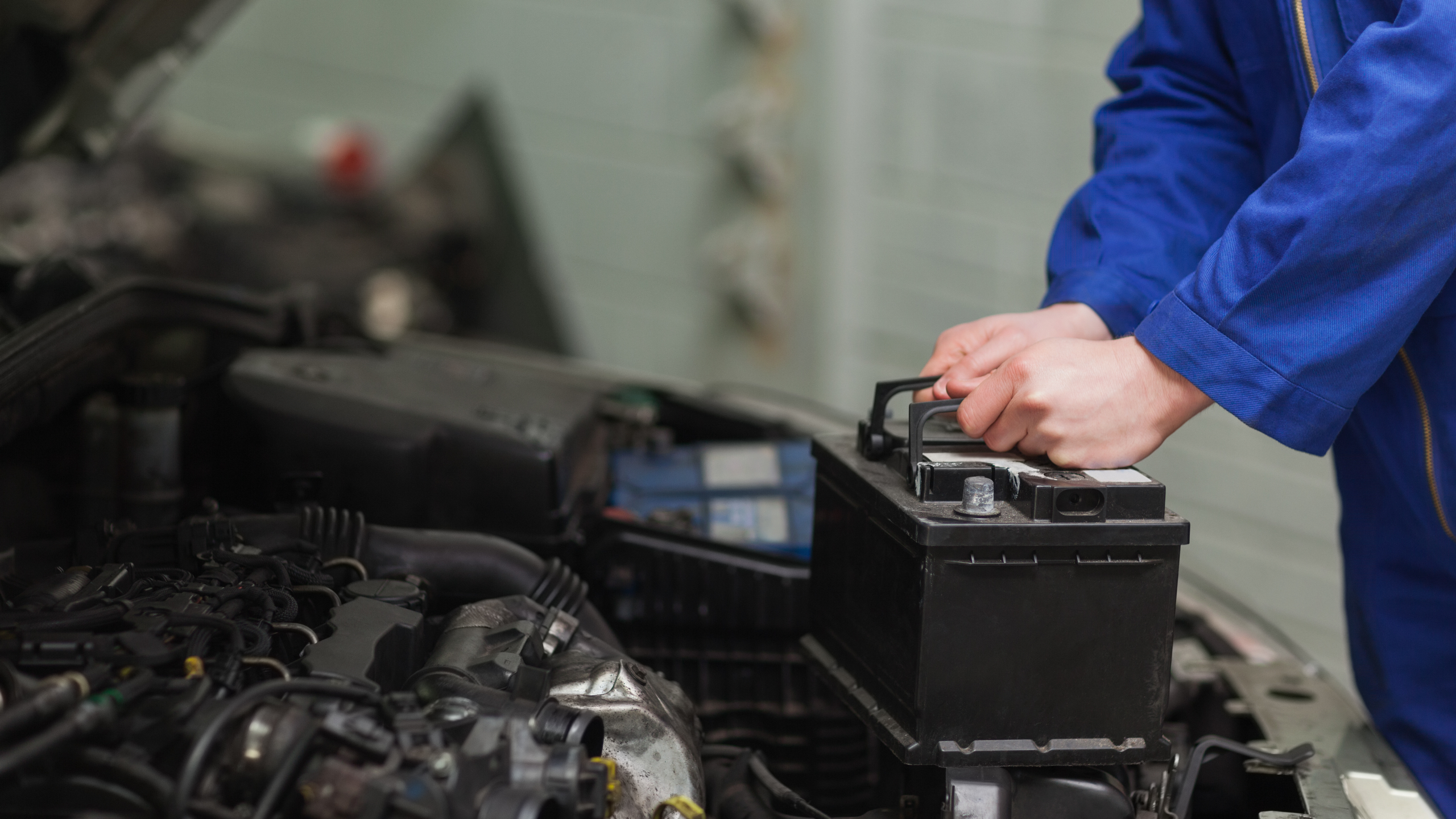
In this article you will find a step-by-step guide to replace a press-in ball joint.
Suspect a possible bad ball joint? Then you’re serving your customer well by being proactive about the repair for such a safety-critical part. Replacing a ball joint won’t be the same process for every vehicle, especially since there are several different kinds of ball joints. In the video below, we’ll take a look at how to replace a press-in ball joint. Specifically, we’re looking at a Honda Civic, which Delphi covers with our part TC1299.
We’ll explain the full process below the video as well.
How can I tell if my customer’s car has a bad ball joint?
We recommend a thorough pre-alignment inspection. Some common signs include:
- Unusual noises
- Instability
- Handling concerns.
What should I look for when inspecting a ball joint?
Keep in mind that integrity of the rubber boot is the key. A common problem is that the boot will split, grease will leak out, and cause problems. Generally when inspecting a ball joint, we look for movement outside of manufacturers’ specifications, but with low friction non greaseable joints you should look for seized joints that show no movement.
What tools will I need for a press-in ball joint replacement?
- Ball joint press kit (including C-clamp and adapters)
- Socket, ratchet, torque, and extension wrenches
- Socket air tools
- Ball joint separator (also known as a pickle fork)
- Needle nose pliers
- Screwdrivers
- Tire iron
- Side cutters
- Axle press
- Hammer
- Shop towels
- Rust penetrant
Steps to replace a press-in ball joint
Make sure you follow manufacturers’ recommendations for installation, torque specs, and TSBs where applicable.
Removing the ball joint
- Use side cutters to remove the cotter pin that’s securing the fastening nut.
- Use a socket wrench to remove the fastening nut.
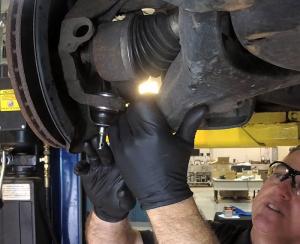
- Use a socket wrench to remove the axle nut.
- Push the axle back through and loosen the knuckle assembly, moving it to gain access to the ball joint.
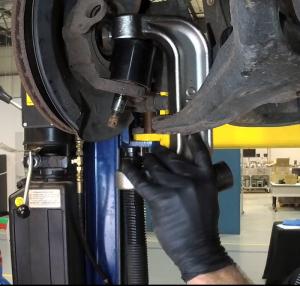
- Separate the ball joint from the lower control arm with your ball joint separator. You can operate the tool with a socket wrench, using an appropriately sized socket. You will hear a crisp, clear snap when the stud pops loose from the lower control arm.
- Push the axle shaft back through the hub assembly. You may need to use an axle press and a socket wrench to get things started because often the axle can become dry or stuck over time. Make sure you can swing the axle shaft clear and prop it up (perhaps with a piece of wood or a tool). This frees up the lower ball joint.
- Push the outer CV joint back through the hub assembly to loosen it up, but make sure you don’t pull the inner CV joint out of the transmission. You only want to remove the knuckle and assembly.
- Remove the axle press with the socket wrench.
- Remove the knuckle and the strut assembly out so your press can access the ball joint.
- Remove the rubber boot by knocking it off with a hammer and screwdriver. The new ball joint comes with a new boot so you don’t have to worry about protecting the old one. Clean off the exposed ball joint stud with a shop rag.
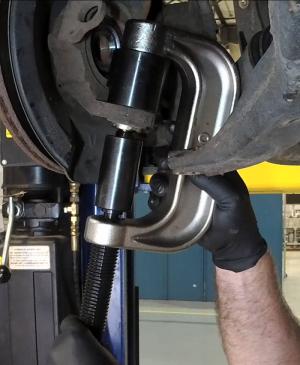
- Set up your ball joint press. The adapters you’ll need to use are vehicle-specific. The upper and lower cone will fit together on top and bottom of the ball joint.
- Run the press inwards to press out the old ball joint with the socket wrench and ball joint press.
- Remove the top and bottom accessories and remove the old ball joint. If it comes out cleanly with the press, just double check that there are no edges to be concerned about on the steering knuckle, and no hidden damage.
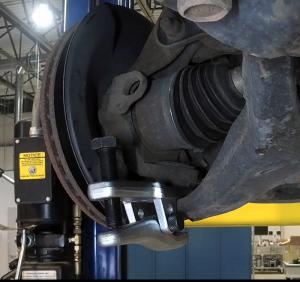 Set up ball joint separator tool. | 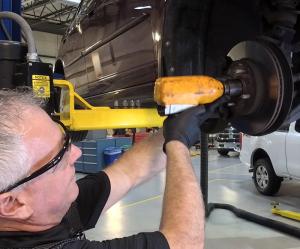 Remove axle nut. |
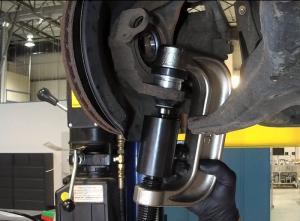
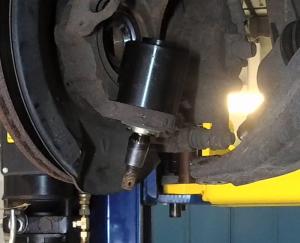 Fit upper adapter onto ball joint. | 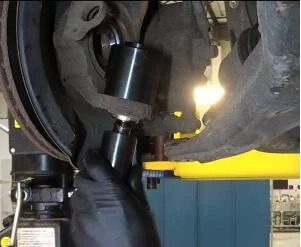 Fit lower adapter onto ball joint. |
Replacing the ball joint
- It’s a good rule of thumb to always check the new and old components side by side to make sure your new part matches the one coming out. Take off the new retaining nut and plastic shipping cover.
- Insert the new ball joint into the knuckle and make sure it’s level.
- The adapters to install the ball joint are different from the ones you used to remove the old one. A small specially designed adapter fits tightly over the upper portion of the ball joint. Fit this on, and place the press on top of the upper adapter.
- The lower adapter fits over the large ball joint screw under the ball joint, with room for the stud and threads so that they won’t get damaged during the installation process.
- Make sure everything is square and true to the knuckle, and wind the press up to tighten it by hand. It’s very important to press the joint in in a level and square manner, with the joint centered and aligned to the knuckle. Wiggle while tightening to make sure everything remains straight.
- Once you are sure you have clearance and everything is safe and secure, use a socket wrench to finish pressing in the ball joint with the press.
- Once the upper mating surface of the joint meets securely with the knuckle, you can remove the press. Make sure that the rubber boot hasn’t been nicked or touched, and that the threads remain safe and undamaged. Check that the ball joint has pressed fully down.
- Begin working the axle shaft back into the wheel bearing. Apply a bit of rust penetrant to help it slide back in properly. Match the splines into the hub.
- Re-secure the knuckle and the new ball joint stud to the lower control arm. Make sure the axle is feeding through properly and starting to poke through the outside of the hub assembly.
- Add the securing nut and tighten with a socket wrench.
- Add the cotter pin.
- Reinstall the axle nut and torque it to manufacturer specifications. If it’s not all the way through, you can grab the outside CV joint to help you.
- Finally, you can safely lower the vehicle to the ground. Finish up the job by taking the vehicle to get an alignment.
Now you’ve done it! A safe and successful press-in ball joint replacement.
 |  |
 |  |
Do I need a retaining clip?
For this unit TC1299 there is no need for a retaining clip (or snap ring). There was no retaining clip in the OE unit and the Delphi OE design is exactly the same, so a clip is not necessary. The new part comes with a cotter pin and the nut for a complete installation.
How many times can I replace a ball joint on the same vehicle?
Follow manufacturer recommendations. For this part, TC1299, only one replacement opportunity is possible per the OE. If the joint needs to be replaced again, the OE recommends purchasing a new knuckle and ball joint, and replacing both.
A few safety tips:
- It’s important to use a proper ball joint press. In the past, ball joints could be punched or hammered out, but this is no longer best practice.
- Make sure you have room to work. The ball joint press needs a certain amount of space, so it’s preferable to use a hoist. If you’re working on the ground with axle stands, make sure you have enough clearance on the ground.

Visit our Technician Library for access to Documents and Downloads
Get in touch

Contact Us
Visit our Contact hub to find a range of enquiry types suited to help you find the exact support you are looking for.