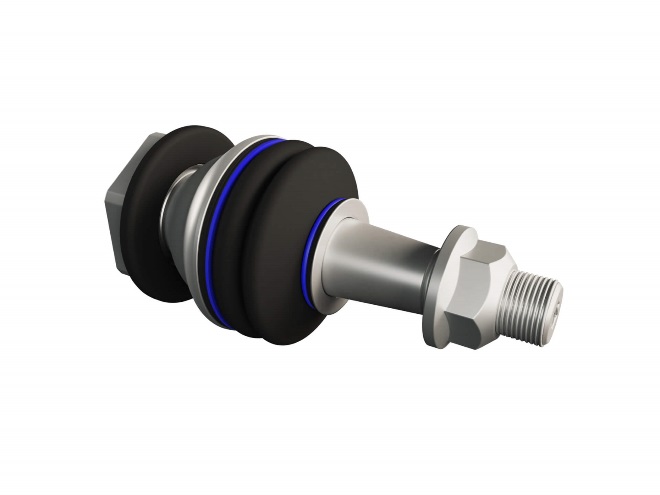
- Product Information
- Product Resources
- Enquire
- Related Products
Why should you trust Delphi for ball joints?
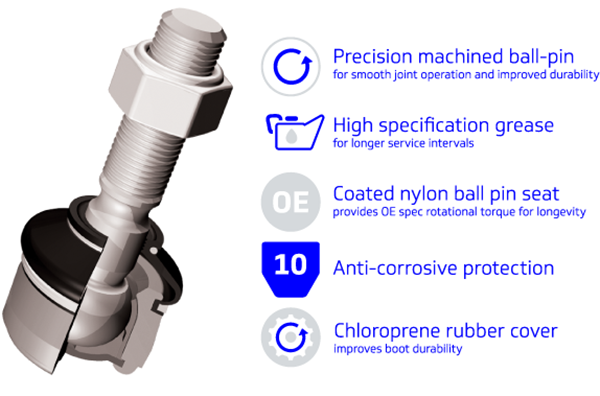
- Manufactured with high-quality forgings for increased strength and smooth operation.
- Chloroprene rubber boot improves durability and prevents premature failure, with cover to protect internal components.
- Machined to micron tolerances to guarantee durability and smooth joint operation.
- Anti-corrosion protection applied to each part.
- Ball-pin 100% crack tested for flaw free material.
- Undergo rigorous performance and resilience tests.
- Superior ball-pin finish and nylon seat coating for smooth movement and long lifetime.
- High specification grease for reduced friction, and smooth operation in all temperatures and conditions.
What does a ball joint do?
Think of the ball joint like a human hip joint. It acts as a pivot between the vehicle’s wheels and suspension, allowing the vehicle to be steered while ensuring a comfortable ride.
Why does a ball joint fail?
The ball joint’s constant motion subjects it to significant stress and wear. If it is worn out or its rubber boot splits or cracks, it needs to be replaced. So, you’ll want to fit a high-quality ball joint that has been designed, engineered and manufactured to the same standards as OE. Make sure to replace the entire ball joint and not just the ball joint boot. A damaged boot can let in contaminants that could corrode and/or impact the smooth feel of the ball joint. It can also lose grease lubricant, which is intended to last the life of the joint, causing significant friction and possible sticking.
Learn more about ball joint failure symptoms.
Precision engineering
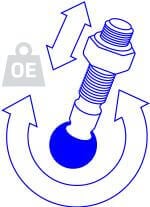
Enabling free movement in two planes at the same time, the ball-pin is a critical component. That’s why our ball-pins are manufactured from high-grade steel and machined to micron tolerances. Together with a polyoxymethylene nylon ball-pin seat, they provide optimum durability and smooth joint operation.
Extensive testing
Delphi ball joints undergo rigorous performance tests including angular stress testing, where the ball is rotated through its angular and rotational travel under load, as well as a pull and push out test, to measure the force required for it to break away from the housing. These important safety tests ensure the ball joint can withstand the same forces as the OE part.
Cataphoretic coating
Like many of our steering parts, Delphi ball joints feature an environmentally friendly cataphoretic coating for tougher and longer lasting protection from corrosion caused by salt, dirt and water and other contaminants.
Greater protection
To help prevent damage to the joint’s internal components, all our ball joints come with a special chloroprene rubber cover. The new and improved formula maintains its durability even in extreme temperatures, providing added protection from road dirt or salt and allowing continued free movement of the ball joint for a longer lasting par
Longer service intervals
We provide a range of sealed ball joints, that are lubed for life with a high-specification grease, to minimize maintenance requirements. Alongside our precision ball-pin finish and improved rubber boot design, they offer longer ball joint service intervals and better grease retention.
Click here to view our catalog
The Delphi Difference
-
100 years of OE experience, supplier to the world’s top automakers
-
OE heritage and knowledge built into every aftermarket part
-
Comprehensive portfolio for a wide range of vehicles and model years
-
Streamlined SKUs for easy inventory management
-
Support through tools, tips and training

Related product resources and downloads
Resource Highlights
In this article you will find out about suspension bushes:
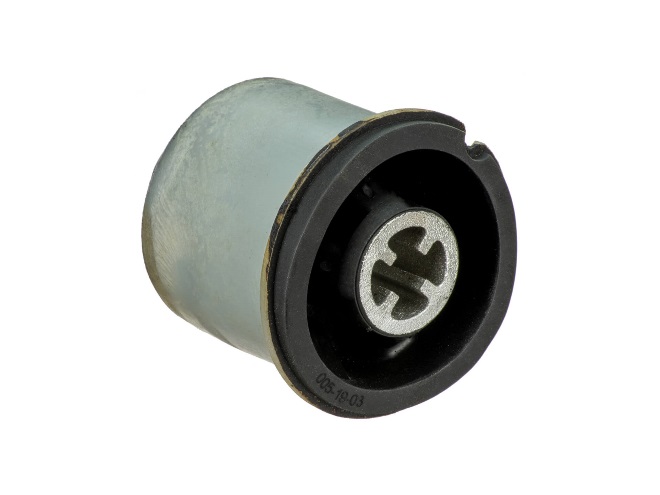
Bushes play a pivotal role in the steering and suspension set-up of modern vehicles, allowing the suspension parts to move freely, whilst at the same time, absorbing noise, shocks and vibration. Since a worn or damaged bush will negatively impact these functions, it’s important to inspect them regularly and replace whenever necessary. Here we give you the full picture on automotive bushes; what they do, how they’re made and why and how they fail, so on your next steering job you can be sure to get straight to the point.
What is a suspension bushing?
To do its job, a car’s suspension must move up and down. Whilst this a good thing for the vehicle’s ride and handling, this movement can also transmit unwanted noise and vibration through the chassis and into the cabin. Cue the suspension bush! Used in steering and suspension parts, such as control arms, stabilizer bars, ball joints, tie rods, shock absorbers and strut mounts, chassis connection points and engine and gearbox mounts, it provides a location point, connecting other parts of the system together or to the vehicle chassis. Just as importantly, it acts as a cushion, controlling the amount of movement in the joints and reducing road noise, vibration and harshness (NVH) for a more comfortable and safe ride.
What are suspension bushes made of?
Although there are many different designs, based on its location, function and application, most bushes consist of a metal outer, typically made from steel, aluminium and, in some cases plastic, and either a silicone or nitrile rubber inner. Given the high dynamic stresses they are subjected to, this rubber must be resistant to wear, extreme temperatures and contaminants. Because of this, there are also different grades of bushes according to how soft or hard the composite rubber is. This is often referred to as the bushes ‘shore hardness’
Getting the balance right
For a suspension set up that is stiff and maximizes tyre adhesion to the road, a hard bush with very little give is required. However, just like everything there’s a downside, and with improved handling comes the potential for more noise and less comfort. Alternatively, a soft bush with a low shore hardness value will produce less noise, but could compromise the vehicle’s handling. Getting the right balance is therefore critical, and is why all Delphi bushes are engineered to provide the optimum shore hardness value, for both improved handling and noise and vibration reduction.
Why do suspension bushings fail?
Although there’s no set service schedule for suspensions bushes, they can deteriorate over time. Given their position on the underside of the vehicle, bushes are particularly vulnerable to wear and tear from stress caused by constant movement, friction, heat and exposure to dirt and contaminants such as road salts and lubricants. Heat, for example, can cause the rubber to harden or crack, whereas oil can attack the rubber compound. This is a particular problem for bushes located near the exhaust pipe or in a poorly ventilated engine compartment.
What are the signs that a suspension bush needs replacing?
Often a simple inspection will pick up any wear or damage to the bush such as tears in the rubber or breaks in the rubber-to-metal bonding, however, there are a few other tell-tale signs to watch out for - note different types of bush will produce different symptoms:
- Abnormal creaking noises when accelerating or braking
- A clunking noise usually when driving along an uneven surface
- Premature and/or uneven tyre wear
- Metal-to-metal rubbing noises
- A vague or drifting feeling from the steering wheel when turning
- Engine and gearbox mounts can cause vibrations from the front of the car, usually worst when accelerating
Why is it important to replace a suspension bush?
As well as impacting both the vehicle’s handling and driver comfort, worn or damaged bushes can result in metal-to-metal contact. This puts more stress on the joints and connected parts such as control arms, ball joints and shock absorbers, accelerating wear and tear on these parts. Since they can expensive to replace, it’s important to install new bushes at the first sign of any wear.
Key points to consider:
When replacing a bush there are a few things to bear in mind:
- It goes without saying that you should always fit the correct bush for the vehicle – although on the surface they may look the same, there are many internal features designed for the specific application.
- In the case of anti-roll bar bushes, it is advisable to replace in pairs.
- Always carry out a dimensional check of the part before fitting.
- Remember to torque tighten the fixings with the vehicle on the ground. Failure to do so could put unnecessary stress on the bush in the wrong position, resulting in premature failure.
- Some bushes can be difficult to replace and may need specialist pressing tools. In this instance, it can be more economical to replace the entire component rather than just the bush.

Visit our Technician Library for access to Documents and Downloads
Get in touch

Contact Us
Visit our Contact hub to find a range of enquiry types suited to help you find the exact support you are looking for.