Resource Highlights
Current Challenges Heavy-Duty Workshops Face with Diagnostics
Obstacles to accuracy and productivity are common in heavy-duty workshops. The most prominent issues include:
- Multiple tools are required: Many shops have more than one diagnostic tool, depending on the vehicle type. This can cause issues with consistency, since diagnoses are coming from separate systems. This also increases tool costs.
- Integrations represent a challenge: Older technology may not connect to other systems or to a secure cloud. This creates more manual work and problems with syncing.
- The history of vehicle repairs isn’t available: When a truck returns to the shop, technicians may not have access to repair history, as the system lacks traceability.
- Workflows are disjointed: Legacy systems may cause users to be stuck with cumbersome processes. Accessing statistics is a typical workflow barrier.
- Fragmented data: Workshops using multiple tools or lacking integration capabilities don’t have a single source of truth. Data silos like these can impact diagnosis and productivity.
- Electronic Control Unit (ECU) communication is slow: This creates greater waiting time.
- Selective Catalyst Reduction (SCR) / AdBlue could have limitations: SCR / AdBlue are intricate subsystems. Without proper coverage, misdiagnosis could occur.
- Advanced Driver Assistance Systems (ADAS) capabilities have gaps: ADAS has become a common feature in vehicles, and not all systems provide accuracy in this component.
As heavy-duty workshops grow and vehicles become more sophisticated, it’s clear that diagnostic software must adapt. Assessing different platforms should start with benchmarks from the industry.
Evaluating Heavy-Duty Diagnostic Software with Benchmarks
Delphi has a commitment to driving performance and fostering a culture of continuous improvement. As part of this commitment, an independent external organisation was commissioned to conduct a comprehensive benchmarking study of the HD software platform against three of the leading solutions in the market.
The research involved:
- 32 diagnostic function checks
- Multiple live-data assessments
- Hardware comparisons and technician evaluations
- Delphi and three leading heavy-duty diagnostic solution providers
- Four vehicle types: IVECO – Stralis II 2013, SCANIA – Model S 450 2019, RENAULT – Model T 480 2013, and FIAT – Ducato 2024
- Nine categories: Generic diagnostics / features, engine injection, braking system, gearbox, suspension, SCR / AdBlue, air conditioning, instruments, and user experience
The evaluation framework for benchmarking by the third party included:
- Vehicles coverage and system support
- Functionality of diagnostic capabilities
- Hardware connectivity and usability
- Live data access to critical signals
- Productivity and workflow efficiency
- Speed of ECU tests and communication
The Delphi tool achieved strong results across multiple areas critical to workshop success, particularly in accuracy and productivity. The findings reinforce Delphi's dedication to delivering solutions that help technicians work more efficiently while maintaining high standards of diagnostic performance.
Benchmark Highlights
Here are some specific benchmarks with details on performance and the benefits to workshops.
ECU Communication
Electronic signal and data sharing between a vehicle’s ECUs is critical should a vehicle incident occur. ECU communication speeds vary, depending on the makeup of the network protocols in use.
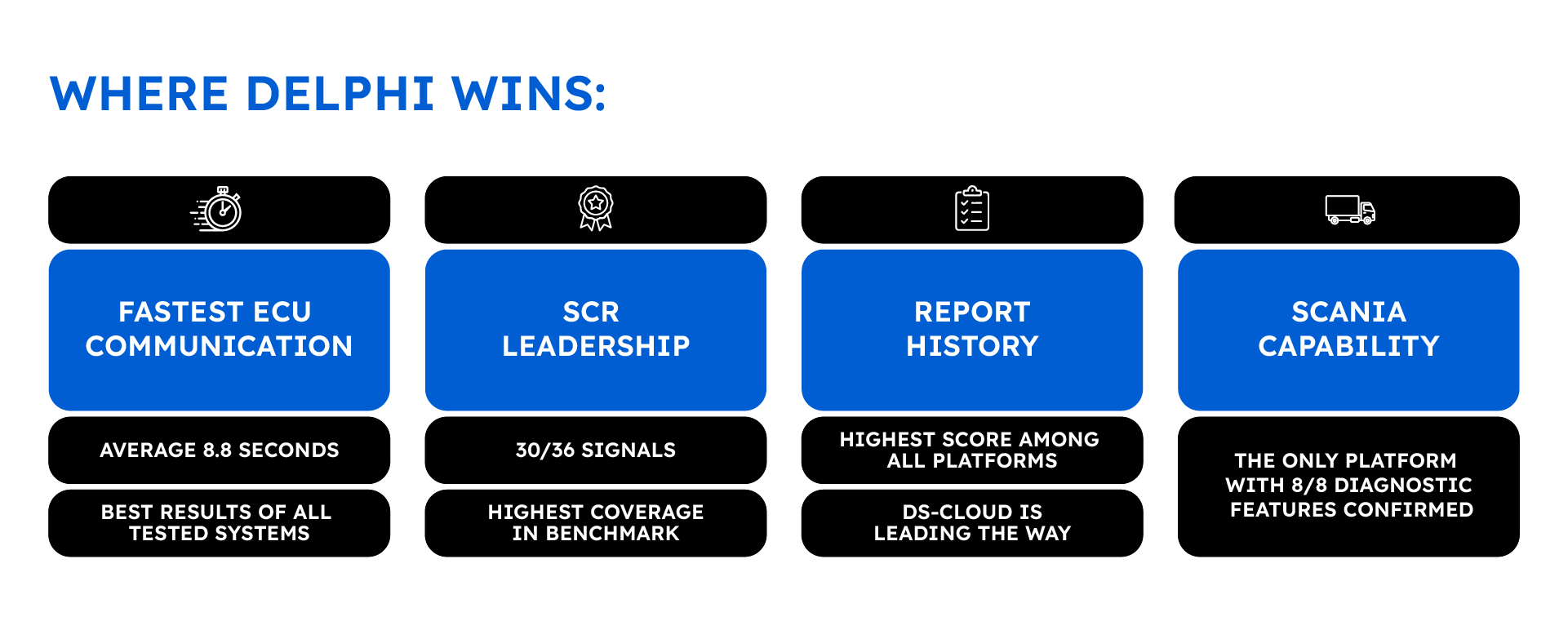
Speed matters here because faster access leads to faster diagnostics, boosting efficiency. Of the four tested software systems, Delphi had the quickest with an average of 8.8 seconds.
SCR Coverage
Not all heavy-duty diagnostic platforms provide access to the same range of system signals. In benchmark testing, Delphi achieved coverage of 30 out of 36 available signals, the highest result among the solutions evaluated. Delphi's strongest performance was seen in the areas most relevant to today's commercial vehicle market, namely diesel-powered vehicles, which account for the majority of the heavy-duty VIO, and light commercial vehicles (LCVs). This extensive coverage enables faster and more accurate emissions system diagnostics, helping workshops reduce AdBlue troubleshooting time, improve vehicle uptime, and increase service efficiency.
Report History
As noted, a challenge workshops face is gaps in report history. This impacts traceability and service documentation. Diagnostics software that offers these features strengthens its maintenance reporting capabilities.
Additionally, shops should adopt software that stores, manages, and synchronises diagnostics data. Technicians can then easily pull up reports, vehicle history, and service data.
Delphi has been recognised as having the highest score across platforms with its DS-CLOUD solution. DS-CLOUD features include real-time syncing, complete traceability to protect workshops, streamlined workflows, and access to data from anywhere.
SCANIA Capability
SCANIA involves eight diagnostic features, and Delphi is the sole provider that has all of these covered. This offers an efficiency advantage for workshops, as most jobs will only require one tool. It reduces dependence on OEM tools as well.
Mixed-Fleet Coverage
Workshops can also consolidate tools with Delphi, as it uses the same platform for trucks, LCVs, buses and trailers. With a single system, shops can reduce their equipment investment. A key difference for Delphi is its performance on the tested LCV FIAT Ducato. It was the only software with SCR capability for this vehicle.
Hardware Mobility
Mobility around the vehicle is vital for technicians when using a wireless vehicle communication interface (VCI). Delphi’s system provides this, which accelerates workshop workflows.
Strong Core Diagnostics
Heavy-duty diagnostic software must have core capabilities that deliver consistent performance in daily operations. Not all solutions have this foundation of diagnostics. However, the study relayed that the Delphi system does this extremely well.
Implementing a Productivity-Focused Diagnostic Platform for Accuracy and Efficiency
The study of leading brands in heavy-duty diagnostic software highlights which ones offer the most comprehensive suite. When workshops evaluate options, there are capabilities that deliver key benefits.
Shops want to get more work done each day, and with Delphi they have a solution designed to support productivity and accuracy. That’s possible because diagnostics are faster, hardware is mobile, there are comprehensive SCR capabilities and vehicles coverage. Service traceability is easy to access and manage.
Workshops can also lower operating costs by relying on a single diagnostic solution, while benefiting from a complete ecosystem of tools that integrates seamlessly both within the Delphi portfolio and with third-party platforms.
Evaluating diagnostic solutions across these criteria, alongside user experience, cost, and overall functionality, helps workshops make informed investment decisions. However, selecting the right platform is not just about meeting today's requirements. As vehicle technologies continue to evolve, diagnostic software must keep pace. Understanding a solution's ability to adapt, expand coverage, and support emerging vehicle systems is therefore essential to ensuring long-term value and future readiness.
SIGN UP TO FIND MORE
Fill up your details to hear more from our experts and get the latest updates from Delphi.
Diagnostics
Discover our extensive range of OE-level diagnostic and test equipment for quicker, more accurate servicing and repairs.

Training
Choose from our expert-led, accredited training courses to enhance your skills and prepare you for the vehicles of tomorrow.
Find out where to buy Delphi parts