
- Product Information
- Product Resources
- Enquire
- Related Products
Latest OE technology
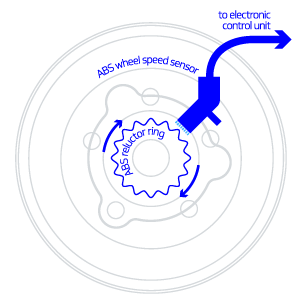
Our ever-expanding range of ABS sensors features the latest digital signal technology. By creating a digital, square wave, Delphi magneto resistive and hall effect sensors only change frequency, not amplitude, improving accuracy, especially at lower speeds. They can also detect the direction of the wheels; forward, reverse and even stop. This is vital for hill hold control, autohold and automatic parking assistance technologies.
Protection from the elements
Given its position, the ABS sensor is particularly vulnerable to contamination from dirt and moisture. That’s why Delphi ABS sensors feature weather-pack connectors that lock out dirt, moisture, chemicals and other contaminants, coupled with plated pins for even great corrosion protection and improved conductivity.
Extreme testing
Water, heat and vibration can all affect a sensors characteristic. So we subject all our sensors to extensive thermal, shock and vibration testing just to be sure. With test temperatures ranging from -40 o C to 140 o C, we know they’ll perform even in the most challenging conditions. Delivering optimum stability and reliability at all times.
Easy installation
For right-fist-time fitment, Delphi ABS sensors are designed to match the OE. With like-for-like mounting and connector designs and wire lengths, technicians can fit quickly and easily, straight from the box.
The complete solution
As well as a growing range of ABS sensors, we also offer advanced diagnostic capability including the ability to read live fault codes and individual wheel speed data, essential repair data through our vehicle technical information package, and expert training and technical support.

The Delphi Difference
-
100 years of OE experience, supplier to the world’s top automakers
-
OE heritage and knowledge built into every aftermarket part
-
Comprehensive portfolio for a wide range of vehicles and model years
-
Streamlined SKUs for easy inventory management
-
Support through tools, tips and training

Related product resources and downloads

Resource Highlights
The AC compressor is the heart of any vehicle’s AC system. It compresses a refrigerant gas, raising its temperature before dumping the heat and letting the gas expand, where it cools. This cooled refrigerant is then pumped into the passenger compartment car.
It’s an essential piece of kit for a comfortable drive, but the way it works in EV vehicles is different to those in standard combustion engines. These differences are important when it comes to vehicle maintenance.
In this video, our Delphi expert will explain everything you need to know – and what to watch out for – when servicing an AC compressor, including:
- How AC compressors in combustion and EV vehicles differ
- The benefits of a voltage-driven AC compressor
- Servicing tips and guidance
How does an AC compressor in a combustion vehicle work?
An AC compressor for an ICE vehicle (internal combustion engine) is belt driven. The belt goes round the crank shaft, spins the compressor and that’s what compresses the gas in the AC system.
How does an AC compressor in an EV vehicle work differently?
The biggest point of difference is that AC compressors for EV vehicles are not belt driven. Instead, they are driven electrically by the high voltage system. Some have an AC input, but the majority are DC powered.
Why do EV vehicles have different AC compression?
By being powered by high voltage (rather than being driven by a belt), means that the AC unit can continue pumping out cool air in all driving modes. An additional benefit is that it also has the ability to heat the interior of the vehicle, as well as cool it, via a heat pump. This works by taking the heat created during the compression of the refrigerant and diverting into an area that requires it.
What do I need to know when servicing vehicles with a voltage-driven AC compressor?
The biggest watch-out is to make sure that you use the correct oil. Combustion engines are most likely to use standard PAG oil, but EV vehicles require a special oil that has low conductivity. If you don’t use it, you’ll most likely cause a short within the phases which will lead to a high voltage error on the vehicle.

Visit our Technician Library for access to Documents and Downloads
Get in touch







Find out where to buy Delphi parts