- Product Information
- Product Resources
- Enquire
- Related Products
Rich OE legacy
Our heritage dates back to the legendary CAV brand, and the introduction of in-line and the iconic DPA pump – the best-selling rotary pump worldwide. Both were revolutionary for their time, setting new standards for reliability and power, and we’ve continued to push the boundaries ever since.
Three choices for fleets
By providing three choices – new, reman and repair – we can provide fleet managers with convenient service and maintenance at a very competitive cost.
Latest generation OE technology
Our latest generation F3 system takes engines beyond the 2021 global emissions and fuel economy regulations and through the next decade. Based on our proven Euro VI Common Rail technology and capable of 3,000 bar injection pressure, it delivers a substantial improvement in emissions, fuel economy and refinement for the lifetime of the engine.
OE-approved repair
In addition to new and remanufactured units, we also offer authorised repair through our global network of Delphi Diesel Centres. Replacing all wearable and performance critical parts, with like-for-like OE, and using OE-approved test plans and equipment, it offers a quality but economical solution.
Find your local diesel specialist here.
Reman
For an equally fast, yet more cost-effective turnaround we offer a range of remanufactured parts. Available off-the-shelf, typically within one to two years of vehicle launch, they are built using OE parts, equipment and processes, and are calibrated to exacting OE specifications.


OE expertise in the aftermarket
Of course, we’re committed to supporting these technologies in the aftermarket. We offer a range of new OE components, identical to those originally fitted, including our pioneering Electronic Unit Injector, Electronic Unit Pump, Smart injector and Multec® Common Rail.
Commercial vehicle diagnostics and test
Our dedicated diagnostic solution for trucks, buses and trailers, supports the key commercial vehicle manufacturers and systems, including the ability to carry out dosing tests, Adblue freeze monitoring calibration, system drain down and regeneration of the SCR system. We also offer a range of OE-approved test equipment for quick and accurate test and repair of the latest heavy duty applications.
Training from the OE experts
Designed to help you prepare for the very latest heavy duty diesel fuel injection technologies, our extensive training programme covers the repair of key systems, including Electronic Unit Injector and Pump and Smart injectors. Learn more about our training.
.jpg?sfvrsn=950636e0_12 "fis_diesel_087_injectors_group_rgb_300.png (1)")
The Delphi Difference
-
100 years of OE experience, supplier to the world’s top automakers
-
OE heritage and knowledge built into every aftermarket part
-
Comprehensive portfolio for a wide range of vehicles and model years
-
Streamlined SKUs for easy inventory management
-
Support through tools, tips and training

Related product resources and downloads
Resource Highlights
In this article you will find out about the step-by-step guidance on injector programming for Toyota D-4D engines.
Vehicle Applications
Engine | Models | Systems |
| Toyota | 1AD-FTV (2L) / 1KD-FTV (3L) / 2AD-FHT (2.2L)/ 2AD-FTV (2.2L)/2KD-FTV (2.4L) | Diesel Systems |
Summary
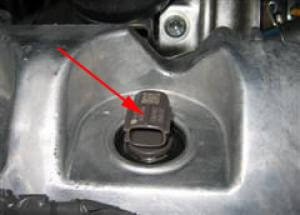
The correction code printed on each injector must be programmed into the engine DCU every time one or more injectors are replaced.
When to Program
This operation must be carried out if:
- One or more injectors have been replaced.
- The DCU has been replaced (a new DCU must always be reprogrammed with the codes for all the injectors).
Note: Every injector has its own individual correction code. The code has 30 characters printed on top of the injector. If the correction code programmed in the engine DCU is incorrect for the injector, the engine may stall and run very badly at idle. The engine may also break down and have a reduced service life.
STEP BY STEP
Test Preconditions
- Battery voltage is greater than 12 V.
- Immobilizer switch on run, engine stopped.
- No-fault codes in memory.
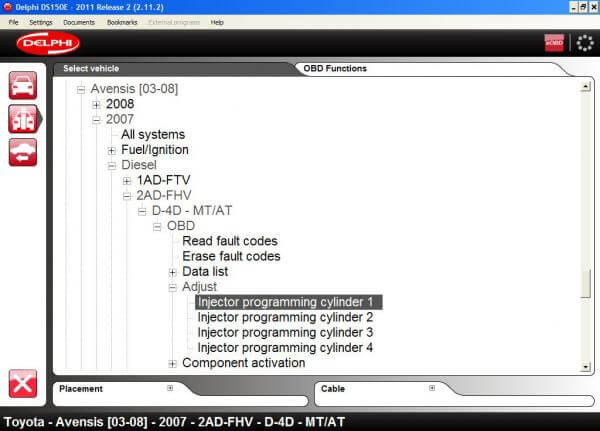
Procedure
1. Select the function: "Injector programming 1, 2, 3 or 4"
2. A dialogue box will be displayed to confirm the code programmed for the injector.
3. Confirm with "OK" to reprogram the injector code.
- If the code is correct, choose "OK".
- To quit the program choose "Abort".
4. Enter the 30 characters of the code printed on the injector (see illustration), then click "OK" to validate.
5. A dialogue box will be displayed to confirm the code chosen; click "Yes" if it is correct.
- Click "No" to stop the programming process.
6. If the programming process has been successful, the old and new codes will be displayed.
7. Confirm with "OK" to finish the process.
8. Check and delete any fault codes.
Caution
If the process has failed, check the fault codes and check that the correct code entered is correct. Even if the correct code is correct and no other fault code is present, the DCU may still not function correctly. Check the engine DCU and restart the operation from the beginning.
Get in touch
Find out where to buy Delphi parts