- Product Information
- Product Resources
- Enquire
- Related Products
Proven durable EV charging cables that last
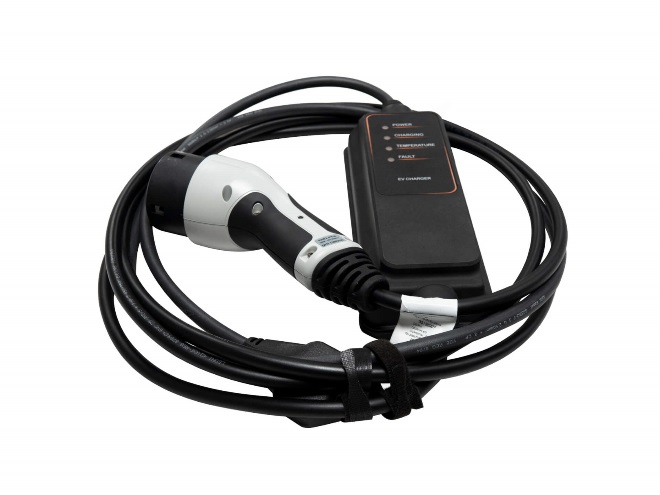
Delphi Charge Mode 2 Cables are in serial production at multiple major OEMs. Tested according to automotive Standards (LV124), our proven design offers reliability and performance that exceed well beyond compliance. The In-Cable Control- and Protection Device (IC-CPD) allows drivers to safely charge their battery-powered electric vehicle (BEV) or plug-in hybrid electric vehicle (PHEV) without the need for a dedicated circuit or EV charging station.
Our robust design of the in-cable control (ICC) box make it not only drive over resistant* (acc. IEC 62196-1) but able to handle extreme temperatures ranging from -30°C (-22°F) to +50°C (122°F), all the way up to +70°C (158.0°F) in storage. With superior water sealing protection* of immersion in 1 meter, well beyond the 5cm standard* (IP67 High sealing performance (1 meter)), the IC-CPD is durable enough for anything nature throws at it.
And to ensure a service life that lasts just as long as the expected battery life of a vehicle, our IC-CPD is designed to last over 10,000 mating cycles- That adds up to a service life of 9 years if used 3 times a day!
Safe EV charging to protect you and your vehicle
When working on anything electrical, safety is our top priority. That’s why Delphi Charge Mode 2 Cables are fully compliant with the IEC 62752 standard and protect you and your vehicle from dangerous electrical faults that can cause damage, shock, fire, or worse.
Shock protection: When the vehicle charging inlet and grid socket are properly connected, all terminal interfaces and terminals are fully protected against contact. Type B RCD residual current detection (RCD) detects fault currents and disable the charging process.
(NA ONLY) Ground monitoring: IC-CPD measures the protective conductor resistance and stops the charging process if the measured value is too high.
Overheating protection: Dual thermal sensors in the grid plug and sensors inside the ICC box monitor temperature.
Short circuit protection: Short-circuit management capability, will the IC-CPD protects on short circuits at EV.
Overvoltage protection: IC-CPD protects EV from overvoltage.
| Countries* | Connector Type | Current | Charge Level | Cable Length (m/ft) | Grid plug type | Part Number |
| North America | SAE J1772 / Type 1 | 10A | Level 1 | 5.0 / 16.42 | NEMA 5-15 / 90° | PLV10001-11B1 |
| Europe | Type 2 | 10A | Level 1 | 5.0 / 16.40 | Typ E/F 90° | PLV10003-12B1 |
| UK | Type 2 | 10A | Level 1 | 5.0 / 16.42 | Typ G | PLV10005-12B1 |
| Switzerland | Type 2 | 8A | Level 1 | 5.0 / 16.44 | Typ J 90° | PLV10007-12B1 |
| Norway | Type 2 | 10A | Level 1 | 5.0 / 16.45 | Typ E/F 180° | PLV10008-12B1 |
| Denmark | Type 2 | 6A | Level 1 | 5.0 / 16.43 | Typ K 90° | PLV10010-12B1 |
| Finland | Type 2 | 8A | Level 1 | 5.0 / 16.41 | Typ E/F 90° | PLV10011-12B1 |
| Italy | Type 2 | 8A | Level 1 | 5.0 / 16.46 | CEI 23-50 / 90° | PLV10009-12B1 |
| China | GB/T | 8A | Level 1 | 5.0 / 16.42 | GB 2099 / 90° | PLV10015-12B1 |
*For a full list of countries available, please contact your Delphi representative.
| What is Level 1 AC charging? | A charging “level” in EV terminology refers to the electric power distribution type, standards, and maximum power of a charging system as defined by SAE J1772 and internationally adopted under IEC 62196-1. Sometimes referred to as “trickle charging”, level 1 charging is perfect for plug-in hybrid vehicles and offers a great alternative charging option by providing a home charging station. By using existing infrastructure, electric vehicle owners save on installation costs while still being able to fully charge their battery overnight. And because the charger is portable, it can easily be stored in any EV luggage compartment, making it perfect for short commutes, overnight charging, or an emergency charge. | A “Level 1” AC charge pulls electrical energy from the power grid via a standard 120V household outlet and capable of supplying an average maximum of 16 A and 1.92kW. The electric vehicle’s on-board charger then converts and stores this energy for the electric motor. Depending on the vehicle, level 1 charging usually takes 12 to 24 hours to get a full charge on a fully depleted battery. |
| What is mode 2 EV charging? | A charging “mode” in EV terminology refers to the mode of power delivery, control, and protective equipment of a charging system as defined by IEC 61851-1, the international standard for electric vehicle conductive charging systems. | “Mode 2" uses a cable incorporated with a protection device to connect the electric vehicle to a household socket outlets. |
Our cables use In-Cable Control- and Protection Device (IC-CPD) to provide a standard grounded power connection to residential building sockets from 100 V to 240 V 50/60 Hz (depending on the model variant) and a charging current of 6 A up to 16 A.
An alternative EV charging option for peace of mind
For drivers that suffer range anxiety- the fear that a vehicle has insufficient range to reach its destination- having a Charge Mode 2 cable available on hand can offer some peace of mind. It also ensures that your vehicle will be charged and ready for use when needed with automatic reset.
Our built-in Auto-Reset feature provides a restart in the event of a temporary power grid fault, such as excessive voltage or a brownout. The charging dock will automatically clear any error codes when the cause of the temporary error condition returns to normal and then attempt to restart the charge.
To learn more about OE quality aftermarket EV parts you can trust, contact your Delphi representative today.
The Delphi Difference
-
100 years of OE experience, supplier to the world’s top automakers
-
OE heritage and knowledge built into every aftermarket part
-
Comprehensive portfolio for a wide range of vehicles and model years
-
Streamlined SKUs for easy inventory management
-
Support through tools, tips and training

Related product resources and downloads

Resource Highlights
Accidents happen – but sometimes a quick fix is not the answer.
EV charging plugs are more complex than standard mains ones – so if you damage one, it’s better to replace than try to repair. In this video, watch as Laura, our Delphi expert, explains why.
Why is a charging plug more complex than a mains plug?
A charging plug has earth, live and neutral wires as per mains, but it also has two additional wires for measuring the temperature of the plug. This is because heat can easily build up over the long period of charging, and by monitoring the temperature the charge level can adjust to avoid overheating.
How do I tell if an EV charging plug is damaged?
The most obvious way to tell is visually – if the exterior has been damaged by accident. However, other symptoms of a damaged charging plug include little or no power output, inconsistent charging, or intermittent functionality.
What is the lifespan of an EV charger?
Wall-mounted and Level 1 EV chargers typically last for around 10-15 years. Level 2 and 3 chargers are designed for a longer lifespan of 20 years or more. A standard cable used with EV chargers typically lasts for over 10,000 full charges.
Can I use an extension cable for EV charging?
It’s always best practice to plug directly into the mains. Standard household extension leads are not designed for several hours of EV charger use.

Visit our Technician Library for access to Documents and Downloads
Get in touch

Find out where to buy Delphi parts