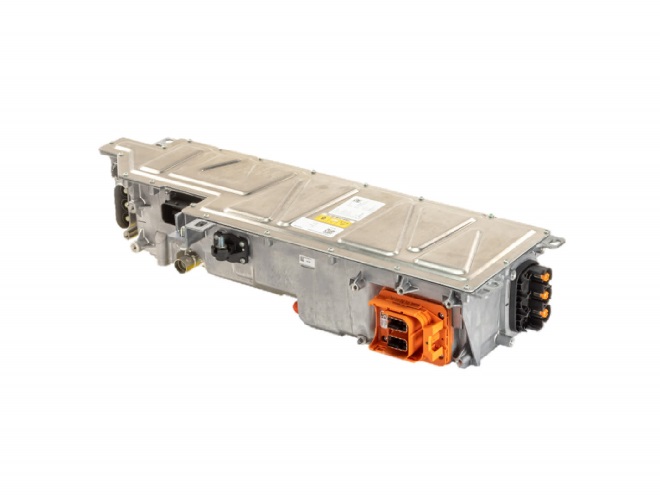
- Product Information
- Product Resources
- Enquire
- Related Products
OE Part Number | Applications | DT Part Number |
12368487431 | BMW 225XE (F45) , X1 (F49), M5 Sedan (F60) | PFV10000-12B1 |
What is the difference between an inverter and DC/DC converter in an electric vehicle?
Much like how internal combustion engines and alternators work together on conventional vehicles, hybrid cars and electric motors use inverters and converters to manage power to and from the battery pack to the motors and other on-board systems.
Inverters transform direct current (DC) from the battery into alternating current (AC) to power the vehicle. Inverters also control the motor and convert it to a generator, transferring braking energy back into the battery.
Converters control the DC voltage from the battery, either stepping it up or down based on the system and the power needed. DC/DC converters usually step down the high voltage from the battery pack to the 12-volts used by radios, headlights, and more.
An OE solution for aftermarket power electronics
Inverters and converters work together to manage the vehicle's electric drive and accessory systems. However, many of today’s inverters and converters can be complex, expensive, and prone to failure from excessive heat. They are also heavy and take up a lot of room on the vehicle, compromising both trunk and passenger compartment space. Delphi OE solution combines the inverter and DC/DC converter into one unit.
Delphi CIDD is cost-effective and saves vital weight and space in hybrids (HEV), plug-in hybrid electric (PHEV), and electric vehicles (EV). And by leveraging patented OE technology - Viper-enabled inverter’s double-sided cooling - it tackles the issue of overheating, allowing higher power outputs from a smaller package and increased range.
Combined Inverter and DC/DC Converter (CIDD)
- Enhances durability and reliability through features designed to withstand under the hood and environmental factors such as debris and temperature extremes.
- Improves voltage distribution functionality, enabling both low-side and high-side power for everything from headlights to power steering and air conditioning systems.
- Provides maximum packaging flexibility and space savings by moving the DC/DC unit from its standard location in the rear to the front of the vehicle.
- Enables better power range and minimizing power losses through the elimination of cabling, cooling hoses, connections, and housings, all while simplifying maintenance and repair.
To learn more about OE quality aftermarket EV parts you can trust, contact your Delphi representative today.
The Delphi Difference
-
100 years of OE experience, supplier to the world’s top automakers
-
OE heritage and knowledge built into every aftermarket part
-
Comprehensive portfolio for a wide range of vehicles and model years
-
Streamlined SKUs for easy inventory management
-
Support through tools, tips and training

Related product resources and downloads

Resource Highlights
Electric vehicles (EVs) are the future of the automotive industry. Technicians committed to staying on the cutting edge of their industry must be familiar with how EV batteries work and how to ensure their health.
Regular testing and maintenance enable you to catch problems early on so your clients can enjoy optimal performance, extended battery life, and reliable operation of their vehicles. But with technological advancements, keeping pace with evolving diagnostics can be a challenge. Delphi is here to help.
Upgrading Your Diagnostic Tools
To perform the original equipment (OE) EV battery health test routine, you may need to unlock the Security GateWay (SGW) depending on the brand. However, older diagnostic tools like the DS150 and DS450 cannot access this feature.
For this reason, we highly recommend upgrading to a DS180 or DS480 solution. These newer tools enable you to perform comprehensive tests and access the SGW for detailed diagnostics.
Comprehensive EV Battery Health Testing
Delphi has defined EV battery health testing across seven categories:
Voltage Test (No Load)
This measures the voltage of each module or cell without any load.
You can then compare the voltages; a variance greater than 40mV warrants further investigation.
Voltage Test (Light Load)
This looks at the voltage under a light electrical load, typically under 10kW. It helps identify voltage stability under normal operating conditions.
Voltage Test (High Load)
Using this test, you can monitor voltage during full acceleration. A major voltage drop indicates poor cell or module capacity.
Capacity Test (Ah)
You can drain the battery to its cutoff voltage and then recharge it. During this process, you can measure the actual capacity and compare it to the original specification.
Thermal Test
This test checks the battery's thermal management system for leaks. You can ensure the coolant or refrigerant is functioning correctly.
Integrity Test (Pressure)
Use this category to check the physical integrity of the battery pack. It uses pressure or vacuum tests to inspect the casing for external breaches.
Internal Inspection
Finally, this test involves a visual inspection of all connections, joints, and the casing. This is typically done during battery repair or refurbishment.
How These Tests Tie Into Battery Classifications and Components
To give you some more context on these tests and how they work together, let's break down the basics of EV batteries.
Battery Classifications
EV batteries are categorised based on their voltage and configuration:
- High voltage (HV) batteries range from 48V to 1,000V.
- Cells are the building blocks of the battery and are usually between 1.2V and 4.2V each.
- Modules are groups of cells that work together.
- Packs are multiple modules that form the complete battery pack.
Knowing these components helps you see where each test fits in and why it matters. For example, understanding cell configurations (series vs. parallel) can help you clarify why certain voltage drops happen during a high-load test.
Battery Components
The main components of an EV battery include:
- Cells
- Coolant/refrigerant
- Heating elements
- A sealed case
- Connections
- Relays
- The Battery Management System (BMS)
- Current sensors
- Temperature sensors
Each of these parts contributes to the battery's performance and safety. For example, the BMS monitors the state of the battery and ensures it operates within safe limits. Current sensors measure the flow of electricity, and temperature sensors keep track of the battery's heat levels to prevent overheating.
The OEM test
Different OEM’s have different tests categories within the BMS, this is the test that the Delphi diagnostic solution can access.
Some OE’s chose a simple light load voltage test, others carry out a more in-depth voltage and capacity test.
Whichever it is, the Delphi diagnostic solution has you covered.
At the Forefront of Your Industry
Using the latest tools and following recommended test routines positions you at the forefront of the EV revolution. Upgrade your diagnostic tools today, and make sure your workshop is ready to handle tomorrow's demands.

Visit our Technician Library for access to Documents and Downloads
Get in touch

Find out where to buy Delphi parts