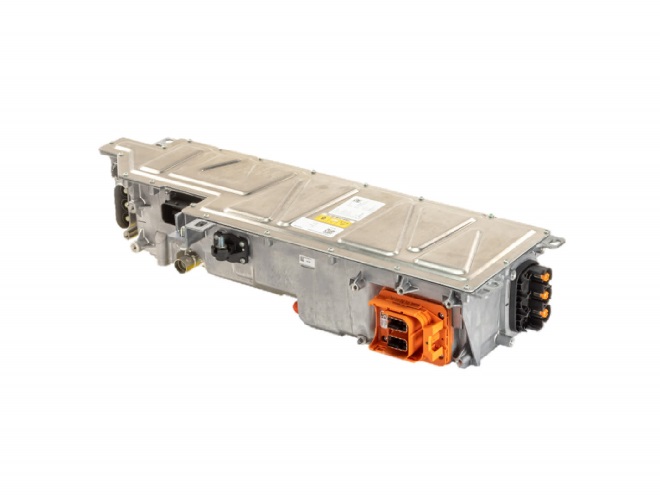
- Product Information
- Product Resources
- Enquire
- Related Products
OE Part Number | Applications | DT Part Number |
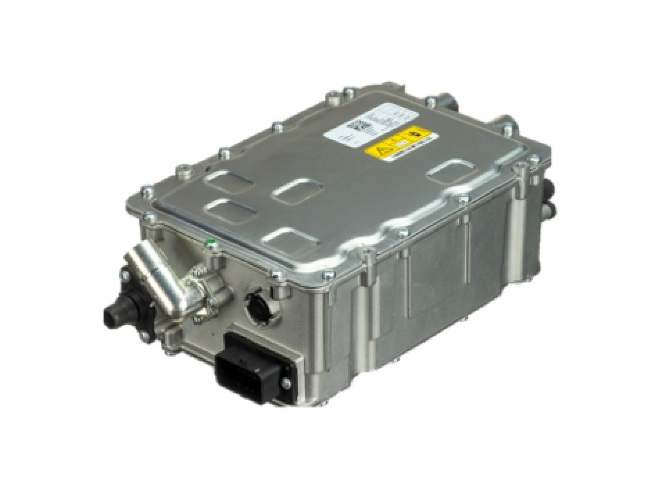
12368487431 | BMW 225XE (F45) , X1 (F49), M5 Sedan (F60) | PFV10000-12B1 |
What is the difference between an inverter and DC/DC converter in an electric vehicle?
Much like how internal combustion engines and alternators work together on conventional vehicles, hybrid cars and electric motors use inverters and converters to manage power to and from the battery pack to the motors and other on-board systems.
Inverters transform direct current (DC) from the battery into alternating current (AC) to power the vehicle. Inverters also control the motor and convert it to a generator, transferring braking energy back into the battery.
Converters control the DC voltage from the battery, either stepping it up or down based on the system and the power needed. DC/DC converters usually step down the high voltage from the battery pack to the 12-volts used by radios, headlights, and more.
An OE solution for aftermarket power electronics
Inverters and converters work together to manage the vehicle's electric drive and accessory systems. However, many of today’s inverters and converters can be complex, expensive, and prone to failure from excessive heat. They are also heavy and take up a lot of room on the vehicle, compromising both trunk and passenger compartment space. Delphi OE solution combines the inverter and DC/DC converter into one unit.
Delphi CIDD is cost-effective and saves vital weight and space in hybrids (HEV), plug-in hybrid electric (PHEV), and electric vehicles (EV). And by leveraging patented OE technology - Viper-enabled inverter’s double-sided cooling - it tackles the issue of overheating, allowing higher power outputs from a smaller package and increased range.
Combined Inverter and DC/DC Converter (CIDD)
- Enhances durability and reliability through features designed to withstand under the hood and environmental factors such as debris and temperature extremes.
- Improves voltage distribution functionality, enabling both low-side and high-side power for everything from headlights to power steering and air conditioning systems.
- Provides maximum packaging flexibility and space savings by moving the DC/DC unit from its standard location in the rear to the front of the vehicle.
- Enables better power range and minimizing power losses through the elimination of cabling, cooling hoses, connections, and housings, all while simplifying maintenance and repair.
To learn more about OE quality aftermarket EV parts you can trust, contact your Delphi representative today.
The Delphi Difference
-
100 years of OE experience, supplier to the world’s top automakers
-
OE heritage and knowledge built into every aftermarket part
-
Comprehensive portfolio for a wide range of vehicles and model years
-
Streamlined SKUs for easy inventory management
-
Support through tools, tips and training

Related product resources and downloads
Resource Highlights
In this article you will find out about the basics of EGRs:
Integral to the vehicle’s engine management system, the aptly named exhaust gas recirculation valve, or EGR valve for short, recirculates finely metered quantities of exhaust gas to the engine intake system for increased engine efficiency, reduced fuel consumption and lower NOx emissions.
With growing pressures to reduce emissions, the EGR valve will play an increasingly important role moving forward. It's important to know what it does, why it fails and how to replace it when it does.
How does an EGR valve work?
Nearly 80 percent of the air we breathe is nitrogen. However, when it is exposed to the extremely high temperatures in the combustion chamber, plus 1370°C, the normally inert gas becomes reactive, creating harmful oxides of nitrogen or NOx, which are then passed through the exhaust system into the atmosphere.
Examples of harsh environments for EGR valves:
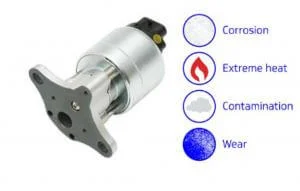
To help minimize this, the EGR valve allows a precise quantity of exhaust gas to re-enter the intake the system, effectively changing the chemical makeup of the air entering the engine. With less oxygen, the now diluted mixture burns slower, lowering temperatures in the combustion chamber by almost 150°C, and reducing NOx production for a cleaner, more efficient exhaust.
The EGR valve has two primary settings: open and closed, although the position can vary anywhere in between. The EGR valve is closed when the engine is starting up. During idle and at low speeds, only a small amount of power is required, and therefore only a small amount of oxygen, so the valve gradually opens – it can be up to 90% open at idle. However as more torque and power is required, for example during full acceleration, the EGR valve closes to ensure as much oxygen enters the cylinder.
As well are reducing NOx, EGR valves can be used in downsized GDi engines to reduce pumping losses and improve both combustion efficiency and knock tolerance. In diesel, it can also help to reduce diesel knock at idle.
Types of EGR valve
Although there are several types of EGR valve -- earlier systems use a vacuum-operated valve, while newer vehicles are electronically controlled -- the main types can be broadly summarized as:
Diesel high pressure EGR valves divert the high-flow, high-soot exhaust gas before it enters the diesel particulate filter – the soot can combine with the oil vapor to create sludge. The gas is then passed back to the inlet manifold either via a pipe or internal drillings in the cylinder head. A secondary valve is also used to help create a vacuum in the inlet manifold as this is not naturally present on diesel engines.
Diesel Low pressure EGR valves divert the exhaust gas after it has passed through the diesel particulate filter -- this gas has a lower flow but is almost completely clean of soot. The gas is then passed back to the inlet manifold via a pipe.
Gasoline EGR valves divert the exhaust gases, much like the high pressure diesel equivalent. The vacuum created by cylinder depression, draws the exhaust gases in and the flow is regulated by the opening and closing of the EGR valve itself.
Vacuum operated EGR valves use a vacuum solenoid to vary the vacuum to the diaphragm and, in turn, open and close the EGR. Some valves also include a feedback sensor to inform the ECU of the valves position.
Digital EGR valves feature a solenoid or stepper motor and, in most cases, a feedback sensor. These valves receive a pulse width modulated signal from the ECU, to regulate exhaust gas flow.
Why do EGR valves fail?
EGR valves operate in a hostile environment so over time will experience wear and tear. However, the single biggest cause of failure is the buildup of carbon particles from the exhaust gases along the EGR and intake system passages. Over time this will clog tubes, exhaust gas channels and eventually the valve’s plunger mechanism, causing it to either stick open or close. Failures can also be caused by a rupture or leak in the valve diaphragm.
What to look out for in a failing EGR valve?
The symptoms associated with EGR valve failure are similar to those of many other engine management components, and because of this EGR faults continue to be a source of headaches for many technicians. However, there are a few signs to look out for:
- Check engine light: as with most engine management components, a problem with the EGR valve may trigger the check engine light.
- Engine performance issues: if the valve is stuck open the vehicle’s air-fuel ratio will be disrupted causing engine performance issues such as reduced power, poor acceleration and rough idle. It may also produce turbo boost pressure leaks, causing the turbo to work harder.
- Increased NOx emissions: when the EGR valve remains shut, the resultant high temperatures in the combustion chamber will leave a lot of unburned fuel in the exhaust, leading to increased NOx emissions and reduced fuel efficiency.
- Engine knock: the higher temperatures and NOx may also result in increased detonation or knock, heard as knocking noises in the engine.
Troubleshooting an EGR valve
Given the different types of EGR valves, it is always best to follow the troubleshooting procedures detailed in the service manual, however, there are a few generic steps that can help to pinpoint diagnosis:
- Check that all vacuum lines and electrical connections are connected and positioned correctly.
- Use a vacuum gauge to check the vacuum supply hose for vacuum at 2000 to 2500 rpm. No vacuum at normal operating temperatures would suggest a loose hose, a blocked or faulty ported vacuum switch or solenoid or a faulty vacuum amplifier/pump.
- Check the vacuum solenoid while engine is running. On electronically controlled EGR valves, activate the solenoid with a scan tool and check the vacuum at end of pipe. If the solenoid does not open when energized, is stuck in the open or closed position or has a corroded electrical connection, loose wire or bad ground, EGR operation will be affected. Identify the root cause before replacing.
- If possible, check the movement of the valve stem at 1500 to 2000 rpm. The valve stem should move if the valve is functioning correctly – if not, and there’s vacuum, there’s a fault.
- Apply vacuum directly to the EGR valve using either a hand vacuum pump or scan tool depending on the type of EGR valve. If there is no change in idle quality, then either the EGR valve is faulty or the passages are completely restricted. If the engine idles rough or stalls, the problem is being caused by a malfunctioning control system.
- Remove the EGR valve and check for carbon build up. Where possible, remove any carbon, being careful not to contaminate the diaphragm.
- Inspect the EGR passageway in the manifold for clogging and clean if required.
Common EGR fault codes
On late model EGR valves the following fault codes are common:
- P0400: EGR flow malfunction
- P0401: EGR insufficient flow detected
- P0402: EGR excessive flow detected
- P0403: EGR circuit malfunction
- P0404: EGR circuit range/performance
- P0405: EGR sensor A circuit low
- P0406: EGR sensor A circuit high
- P0407: EGR sensor B circuit low
- P0408: EGR sensor B circuit high
- P1403: EGR solenoid low
- P1404: EGR system – closed valve pintle error
- P1405: EGR solenoid high
- P1406: EGR system pintle position error
How to replace a faulty EGR valve?
- First remove the engine cover.
- Then loosen the electrical cable on the valve and remove the electrical connections and/or vacuum lines, checking for signs of damage.
- Remove the fastening screws and check the valve for damage, corrosion or carbon build-up.
- Clean the EGR valve mounting surface thoroughly and fit new valve and gasket. Remove any loose carbon from the EGR supply port too.
- Line up the EGR valve with the bolt holes and gasket and reattach to the housing.
- Tighten all fasteners to the recommended torque settings.
- Once firmly seated, reconnect the vacuum lines and/or electrical connections.
- Finally use a diagnostic scan tool to reset the engine management light and check for any other errors. Check that the malfunction indicator lamp has been extinguished, then carry out a road test. Many vehicles now require the EGR
valve to be reset under adaptations. This simply allows the ECU to learn the stop position at the open and closed points. Failure to do this can cause the valve to break and fall into the manifold.

Visit our Technician Library for access to Documents and Downloads
Get in touch
Find out where to buy Delphi parts