- Product Information
- Product Resources
- Enquire
- Related Products
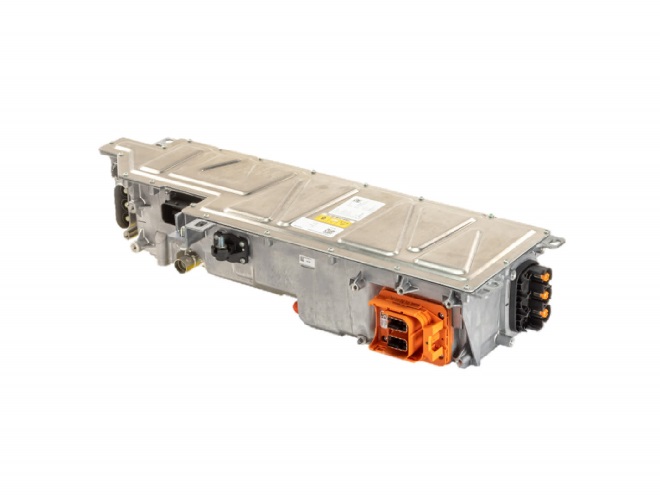
OE Part Number | Applications | DT Part Number |
12368487431 | BMW 225XE (F45) , X1 (F49), M5 Sedan (F60) | PFV10000-12B1 |
What is the difference between an inverter and DC/DC converter in an electric vehicle?
Much like how internal combustion engines and alternators work together on conventional vehicles, hybrid cars and electric motors use inverters and converters to manage power to and from the battery pack to the motors and other on-board systems.
Inverters transform direct current (DC) from the battery into alternating current (AC) to power the vehicle. Inverters also control the motor and convert it to a generator, transferring braking energy back into the battery.
Converters control the DC voltage from the battery, either stepping it up or down based on the system and the power needed. DC/DC converters usually step down the high voltage from the battery pack to the 12-volts used by radios, headlights, and more.
An OE solution for aftermarket power electronics
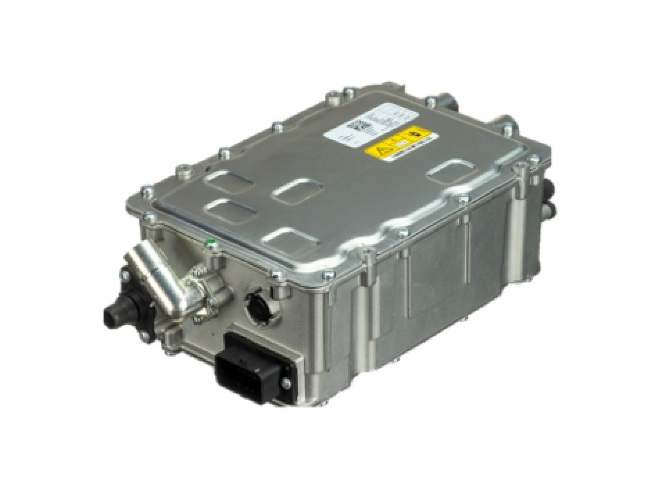
Inverters and converters work together to manage the vehicle's electric drive and accessory systems. However, many of today’s inverters and converters can be complex, expensive, and prone to failure from excessive heat. They are also heavy and take up a lot of room on the vehicle, compromising both trunk and passenger compartment space. Delphi OE solution combines the inverter and DC/DC converter into one unit.
Delphi CIDD is cost-effective and saves vital weight and space in hybrids (HEV), plug-in hybrid electric (PHEV), and electric vehicles (EV). And by leveraging patented OE technology - Viper-enabled inverter’s double-sided cooling - it tackles the issue of overheating, allowing higher power outputs from a smaller package and increased range.
Combined Inverter and DC/DC Converter (CIDD)
- Enhances durability and reliability through features designed to withstand under the hood and environmental factors such as debris and temperature extremes.
- Improves voltage distribution functionality, enabling both low-side and high-side power for everything from headlights to power steering and air conditioning systems.
- Provides maximum packaging flexibility and space savings by moving the DC/DC unit from its standard location in the rear to the front of the vehicle.
- Enables better power range and minimizing power losses through the elimination of cabling, cooling hoses, connections, and housings, all while simplifying maintenance and repair.
To learn more about OE quality aftermarket EV parts you can trust, contact your Delphi representative today.
The Delphi Difference
-
100 years of OE experience, supplier to the world’s top automakers
-
OE heritage and knowledge built into every aftermarket part
-
Comprehensive portfolio for a wide range of vehicles and model years
-
Streamlined SKUs for easy inventory management
-
Support through tools, tips and training

Related product resources and downloads
Resource Highlights
In the first of our two-part series, we explore the latest outlook for hybrid and electric vehicles (HEVs) and the key trends influencing this – namely growing regulation and changing customer perceptions.
Whether a mild hybrid, plug-in hybrid (PHEV), full hybrid or an electric vehicle (EV), they all offload all or part of the work of a conventional internal combustion engine (ICE) to a battery-driven motor. And the trend for doing this is growing quickly with global sales on the rise. But what’s driving the upturn in the hybrid and electric vehicle market? And what will this mean for the vehicle parc that you service?
In the first of our two-part series, we explore the latest outlook for hybrid and electric vehicles (HEVs) and the key trends influencing this – namely growing regulation and changing customer perceptions.
Stricter policy and regulation
One of the key factors is the world’s industrialised nations taking a more aggressive approach on climate change. Case in point: in December 2018, the European Union agreed on even stricter regulations to reduce carbon dioxide (CO2) emissions. The new policy will see average emissions for new cars sold in the EU lowered to around 81g CO2/km by 2025 and 59 g CO2/km by 2030, compared with an average of more than 110 g CO2/km today.
Whilst consumers stand to save over the life of an electric vehicle, upfront purchase costs are significantly higher than for a conventional vehicle. To reduce the gap and encourage EV sales, governments are also offering a range of financial incentives to buyers including tax credits, exemptions from road tax and additional ‘environmental’ bonuses.
At the same time, major cities have announced plans to restrict access to some vehicles. Paris for example, intends to allow only electric or hydrogen fuelled cars in and around the capital by 2030, with older diesel cars banned from summer 2019. London has already implemented an ultra-low emission zone (ULEZ), imposing charges to drive in central London in all but the cleanest cars and vans. And Oxford is expected to introduce a zero-emission zone (ZEZ) in 2020, banning all non-zero emissions vehicles from the centre during certain hours.
Growing customer acceptance
Technology has also played its part. Thanks to optimised lithium-ion cells, the use of new materials and an improved battery pack design, all-electric driving ranges, which until now were one of the biggest barriers to purchase, will increasingly top 200 miles/300 kilometres (kms). For instance, the Nissan Leaf E+ can achieve up to 239 miles/382 kms between charges, and the Mercedes-Benz EQC up to 294 miles/471 kms, making them more comparable with their ICE equivalents. Tesla’s next generation Roadster will be able to top 620 miles/1000 kms per charge, giving us a taste of what is achievable.
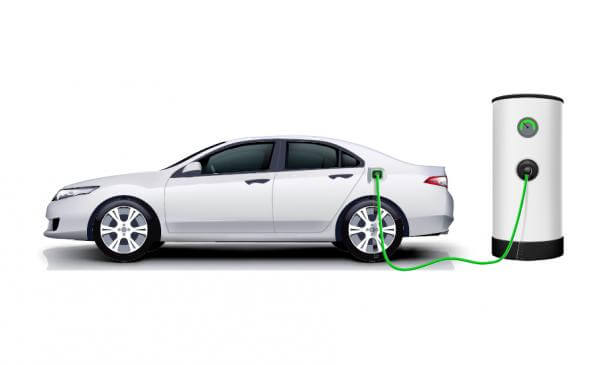
Charging times, however, are going the other way. By 2025 it is estimated that it will take only 30 minutes to achieve an 80 percent change in a 60 kWh battery, the equivalent of a 200 mile range. This is an important threshold for many consumers. And whilst the charging infrastructure may be still lagging by then, governments, automakers, utility companies and third parties are working together to improve public charging. For example, Ionity – a joint venture between Daimler, BMW, Ford, and the Volkswagen Group – aims to set up a High-Power Charging (HPC) network across Europe, with 400 charging stations or 2400 individual charging points by 2020. Others are doing the same.
With these improvements you might expect battery costs to increase. On the contrary, the average cost of a lithium ion battery, which initially accounted for around 50 percent an electric car, will continue to fall. Already 70 percent lower than in 2010, further reductions will lessen the total cost of ownership, with some predicting that this could be on a par with ICE vehicles as early as 2022.
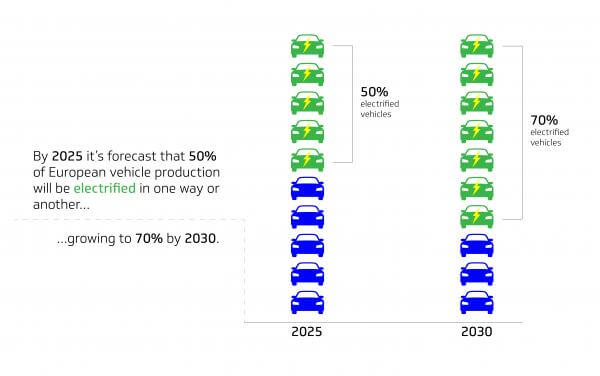
These advances will make HEVs a much more realistic and viable option for any new car buyer. Combined with the push from both government and vehicle manufacturers, there will be a major shift over the next decade, with HEVs coming to our roads in unprecedented numbers. Indeed by 2025, it is forecast that more than half of European vehicle production will be electrified in some form or another. Growing to 70 percent by 2030. And just like their fossil fuel counterparts, these vehicles will all need servicing.
This represents a huge opportunity for garages with the right parts, tools and know-how. But are you ready? In the next of our two-part series, we’ll examine what this means for the aftermarket, and how by partnering with an OE provider like Delphi Technologies, you can take advantage of the electrified opportunity. Both today and tomorrow.
Check out part two: Hybrid and electric vehicles: an electrified opportunity.

Visit our Technician Library for access to Documents and Downloads
Get in touch
Find out where to buy Delphi parts